
A unique lecture/performance program presented by the Scandinavian American Cultural and Historical Foundation and California Lutheran University, made possible by generous grants from the Barbro Osher Pro Suecia Foundation and the Norway House Foundation.
Please visit Nordic Spirit Classics Second Friday Series for information on our monthly series.
Please visit Nordic Spirit Symposium 2024 or Nordic Spirit Symposium 2025 for information about past Symposiums and an example of what you might see at a future Symposium.


Cover photos:
Upper: Sea Stallion photo, Werner Karrasch, Viking Ship Museum, Roskilde, Denmark
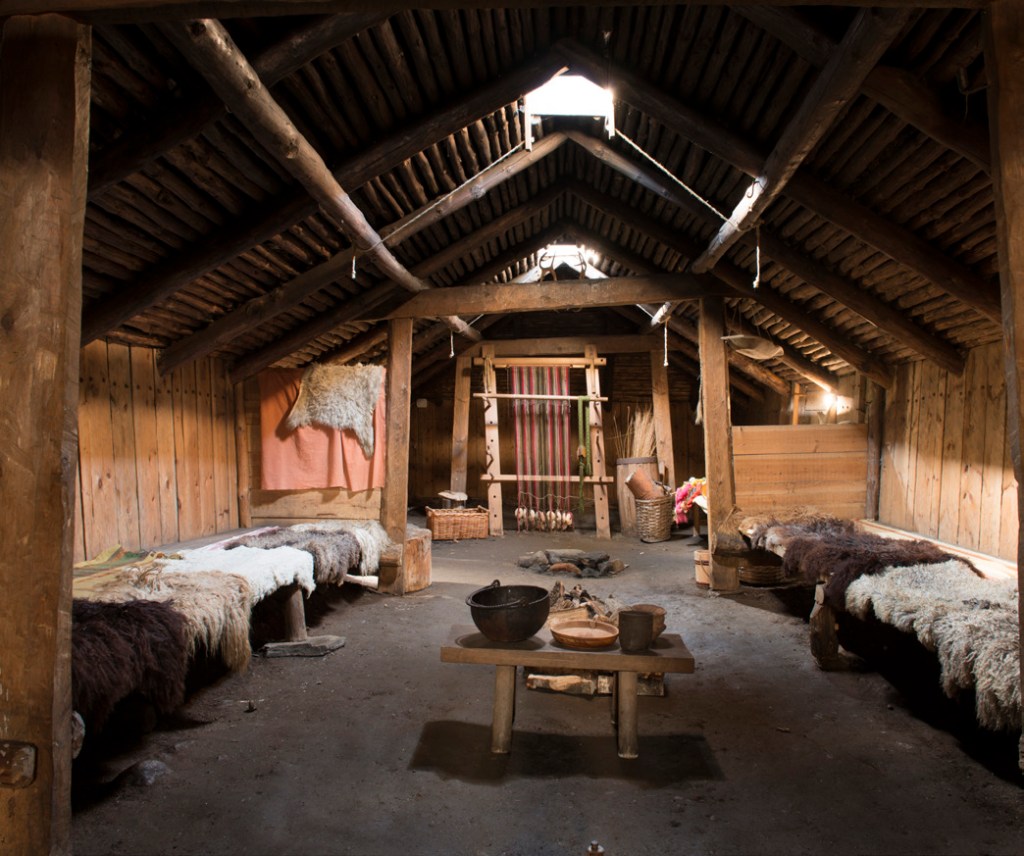
Lower left and right: Reconstructed Iron Age farm in Stavanger, Museum of Archaeology, University of Stavanger, Norway (License: CC BY-MC-ND 3.0).
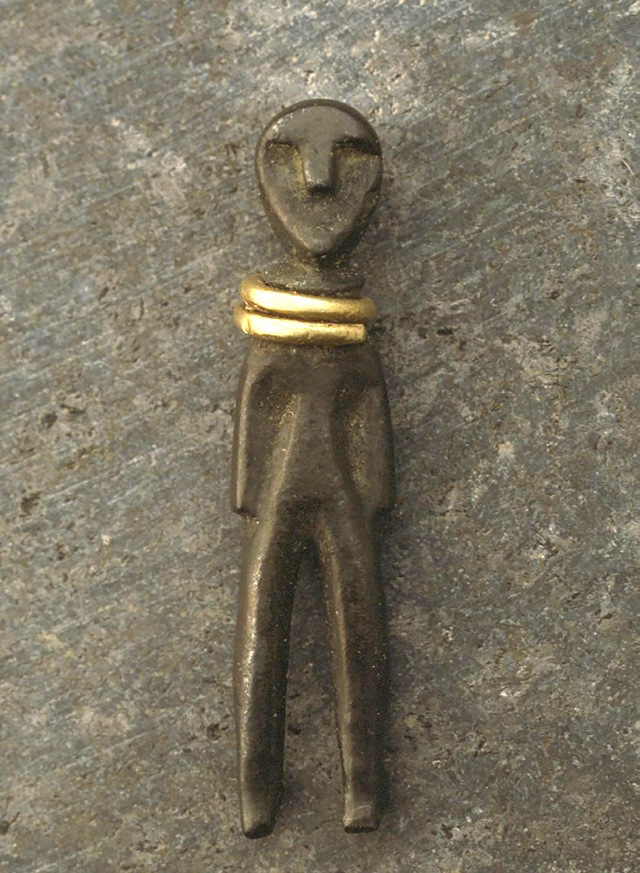
Center: Migration Period figurine, Kymbo parish, Västergötland, Sweden, copper-alloyed silver with gold neck ring, Stockholm, Swedish History Museum, inv. no. 20877, photo Ulf Bruxe (CC BY).
Nordic Spirit presents
The Nordic Iron Age: Life Before the Vikings
The Nordic Iron Age, nestled between the Bronze Age and the Viking Age, saw great changes and developments in society, technology, agriculture, settlement, and more. Seacraft revolutionized travel, trade and cultural exchange. Iron technology revolutionized both tools (e.g., the plow) and weapons. Very practical boats and ships, essential to the Viking Age, were developed in the later part of the Iron Age.
Do you wonder how such graceful, beautiful, and practical craft were developed? Do you wonder what life was like before the Viking Age? This symposium, designed for a public audience, will treat these topics among others. The program will begin Friday Feb. 6 with a live performance of a drama from the Iron Age, Beowulf. Saturday the program will continue with illustrated lectures and music. Discussion of farm life, Iron Age art, and an exceptionally well-preserved and extraordinary 2,000 year-old bog body will fill out the program. We will follow the time-honored tradition of a symposium with music, drama, and ample time for discussion, learning, and enjoyment.
For more information, please contact nordicspiritclassics@gmail.com.
Registration, Reservations, and Event Fees
The symposium is free of charge to enrolled students in good standing. All other attendees will be charged a registration fee of $20.00 for the Friday Evening Symposium Program and a registration fee of $50.00 for the Saturday Symposium Program.
Advance reservations and a fee of $15.00 are requested for the Friday Evening Reception at 5:30 p.m. on February 6, 2026. Lunch reservations for 12:00 noon on Saturday February 7, 2026 will be available at $20.00 per person. Similarly, advance reservations are also requested for the Saturday Evening Dinner and Entertainment at 6:00 p.m. on February 7, 2026. The cost of the dinner and entertainment is $50.00 per person. Reservations for Saturday lunch and dinner are due no later than January 25, 2026.
Registration may be done online or by mail.
For information, please contact nordicspiritclassics@gmail.com.
SCHEDULE
FRIDAY EVENING, FEB. 6, 2026
Overton Hall (off Memorial Parkway)
California Lutheran University
5:30 – 6:30 p.m. Gala Reception – Meet the Presenters
Reservations requested – Admission is $15
Preus-Brandt Forum – California Lutheran University
6:15 – 7:00 p.m. Registration
7:00 – 9:00 p.m. Program
Beowulf
John Heimbuch, Actor, Minneapolis, Minnesota
A live drama from Iron Age Sweden and Denmark will be performed by John Heimbuch. In this play, the hero of the Geats, Beowulf, takes on Grendel, a monster that has been creating great problems for the king. With his famous grip, as strong as that of 30 men, Beowulf tears off the monster’s shoulder and arm. When Grendel dies, Grendel’s mother emerges from a lake to avenge her son’s death.
SATURDAY, FEB. 7, 2026
Preus-Brandt Forum
California Lutheran University
8:15 a.m. Registration
9:00 – 5:15 p.m. Program, Breaks and Lunch
The Iron Age Farm in Stavanger: Research, Reconstruction and Living History
Håkon Reiersen, Ph.D., Museum of Archaeology, University of Stavanger, Stavanger, Norway
In 1972, an Iron Age farm was reconstructed outside Stavanger, Norway, built directly on top of excavated house remains from the 3rd-6th century AD. For over fifty years this has been a center for disseminating Iron Age research and living history. In combination with recent settlement research, the reconstructed farm reveals what life was like in Norway 1500 years ago.
Iron Age Figurative and Animal-Style Art in Scandinavia: From Roman Influence to the Vikings
Nancy Wicker, Ph.D., Distinguished Professor of Art History, The University of Mississippi, University, Mississippi
The art of the Iron Age in Scandinavia drew upon previous indigenous Bronze Age sources and diverse outside influences. Although Romans never invaded Scandinavia, the region was marked by Roman culture, resulting in imagery that was transformed and culminated in the Nordic animal styles. Yet interest in human subject matter continued to reveal both external and internal sources.
12:00 p.m. Lunch Break
1:30 p.m. Afternoon Program
Ships and Seafaring in Prehistoric Denmark
Morton Ravn, Ph.D.,Senior Researcher, Viking Ship Museum, Roskilde, Denmark
Some inventions in human history have changed the world so profoundly that life was never the same again. The boat is one of these inventions. We will follow both the boatbuilder and the seafarer through Denmark’s ancient past, beginning in the earliest Stone Age, more than 7,000 years ago when people hollowed out tree trunks to make log boats, and continuing through stages to the late Iron Age when Scandinavian shipbuilders had mastered their craft to an astonishing degree.
The Finnish Kantele—The Ancient Wisdom of its Strings and Forever Friend of the Singer
Diane Jarvi, Singer, Songwriter, Guitarist, Kantele Player and Poet, Minneapolis, Minnesota
Said to be 1000-3000 years old, the kantele – Finnish folk harp and Finland’s national instrument – has a unique history of accompanying singers of epic poems and inspiring innovative players of instruments ranging from 5- 36 strings over hundreds of years. In this lecture/ performance, Jarvi shares how this instrument continues to sing.
Grauballe Man – a 2,000 Year-Old Iron Age Man
Pauline Asingh, M.A., Curator, Moesgaard Museum, Moesgaard, Denmark
The Grauballe Man is one of the most extraordinary discoveries from Denmark’s ancient past and the world’s best-preserved bog body from the Iron Age. X-rays, CT scans, and analyses of his teeth, hair, bones, and even his last meal have provided valuable insight into his life and death – his health, his age, and the world he lived in. These studies have made it possible to paint a vivid picture of the man and situate him within the society and culture of his time.
SATURDAY EVENING
Lundring Events Center, California Lutheran University
5:30 – 6:00 p.m. Social
6:00 p.m. Dinner, Entertainment – Diane Jarvi
Reservations required. Dinner admission is $50.
This event is partially supported by The Barbro Osher Pro Suecia Foundation, a California nonprofit corporation with an intent to provide support to nonprofit organizations that benefit Swedish education, culture and arts.
This event is partially supported by the Norway House Foundation, a California nonprofit corporation dedicated to honoring the Norwegian seafarers who risked their lives for the Allied cause in World War II. The Norway House Foundation carries out its mission by promoting, encouraging, and supporting educational, professional and cultural exchange between Norway and Northern California.
The organizers reserve the right to make any changes that may be necessary.
 Scandinavian American Cultural and Historical Foundation
